Why the Next Generation of Plumbers, Chefs, and Accountants Are Studying Climate Change
CLIMATE CHANGE
3/9/20264 min read

The Greenville Revelation: Cultivating Solutions in the Lab
Ariel Gilreath, the Hechinger Report
Sun 15 Feb 2026 08.00 EST
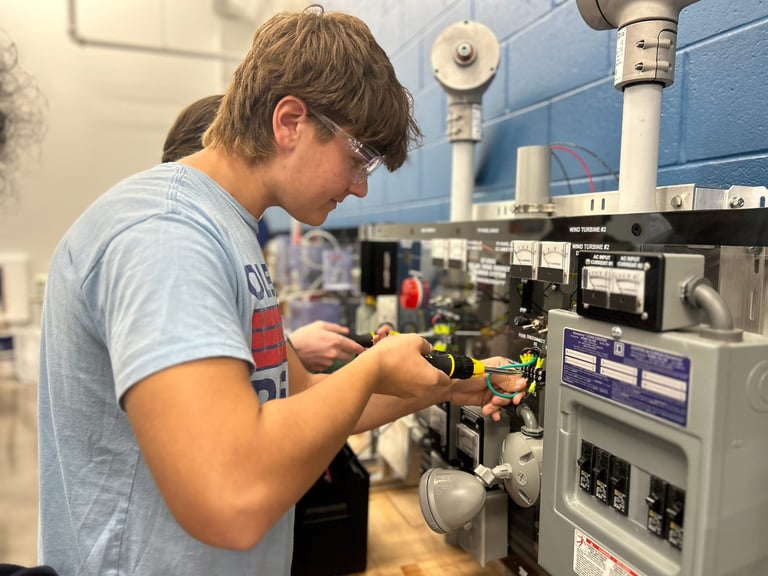
At the Greenville County school district’s Innovation Center in South Carolina, the traditional imagery of vocational training—grease-stained coveralls and manual lathes—is being supplanted by a high-tech laboratory for the future. On one end of the room, high school juniors monitor a drip irrigation system they built from scratch, tending to emerging baby carrots and sprigs of romaine lettuce. On the opposite side, a hydropower model demonstrates how rushing water generates electrical currents.
While these students are mastering the fundamentals of their trades, they are doing so through the lens of renewable energy and labor market resilience. This shift represents a fundamental transformation in American education: sustainability is no longer a niche elective for environmental activists. Instead, it is becoming the cross-sectoral competency required for the 21st-century workforce.
The "Every Job is a Green Job" Philosophy
Rather than isolating climate education in "green-only" silos, forward-thinking districts are weaving sustainability into the very fabric of Career and Technical Education (CTE). Delaware is currently at the forefront of this integrated curriculum-to-career alignment. For Delaware, this is not a pedagogical preference but an existential necessity: as the flattest state in the U.S., it is projected to lose 10 percent of its land to the sea by 2100.
In this model, a carpentry student doesn't just learn to frame a structure; they analyze the health and environmental impacts of dust from wood, plastic, and fiberglass. Crucially, this isn't just about ethics—it's about the bottom line. As Jon Wickert, the state’s director of CTE, notes, if employees remain healthy because they understand environmental hazards, a company’s health insurance and litigation costs drop. This integration treats sustainability as a professional standard rather than a separate industry. As Denise Purnell-Cuff, a key contributor to Delaware’s strategy, explains:
“Every job is a green job. There is no disconnecting how we move forward in any area—there is no separating it from the environment.”
The Economic Shield: Practicality Over Politics
While climate change remains a polarized topic in national rhetoric, the adoption of climate-ready education is proving remarkably non-partisan. In "red" states like South Carolina and Ohio, the driver is global competitiveness and local industrial demand. In Greenville, industry giants like BMW and GE Vernova didn't just endorse the program; they helped decide which courses the Innovation Center would offer to ensure a talent pipeline ready for the transition to electric and hybrid platforms.
This "co-authoring" of curriculum with local industry allows these programs to become recession-proof and decoupled from volatile federal funding cycles. Despite the cancellation of various federal infrastructure grants, local economic necessity keeps the momentum high. In Ohio, three major metropolitan areas have moved forward with climate literacy plans in CTE programs because they recognize that "all manufacturing has a sustainability component."
From Eco-Anxiety to Active Architecture
The push for green skills is also a response to a psychological shift among Gen Z. At Buffalo Grove High School in Illinois, enrollment in the Sustainability Academy has grown more than fivefold since 2023. This surge is fueled by students who have lived through extreme weather and seek to transition from being passive victims of climate change to active architects of its solutions.
By engaging in water chemistry testing in the local Buffalo Creek watershed, students find a sense of agency that alleviates "eco-anxiety." They are seeking the climate literacy required to ensure their professional lives contribute to a stable future. As Dan Hinderliter of Advance CTE observes:
“They want to make sure the world is safe and clean for foreseeable generations.”
High-Tech Innovation and the Senior Capstone
Modern CTE is evolving from simple maintenance into high-level engineering. Students are no longer just fixing what exists; they are inventing what comes next. The depth of this shift is most visible in the senior projects emerging from these labs:
Piezoelectric Power Generation: A Greenville senior developed a piezoelectric plate—a tile that generates electricity when stepped on—with a formal proposal to install the technology in pedestrian areas downtown to power city infrastructure.
Algae Biofuel Research: Students are utilizing ultrasonic frequencies to release lipids from algae, perfecting the chemical conversion process required to create viable biofuels.
Advanced Automotive Systems: Moving beyond the internal combustion engine, students are mastering the complexities of electric and hybrid vehicle systems, aligning themselves with a global market where EVs are projected to account for two-thirds of all car sales by 2030.
The Rise of the Green-Collar Middle Class
This movement isn't restricted to future scientists or those pursuing four-year degrees; it is a pragmatic ladder to middle-class stability. The pathways being built in these schools lead directly to high-growth roles for energy auditors, electricians, and advanced manufacturing technicians—jobs that often require specialized certification rather than a university diploma.
By providing these skills at the high school level, districts are offering a head start in an economy rapidly shifting toward a global energy transition. Whether a student enters a local community college electrician program or goes straight to a manufacturing floor, they graduate with the specialized knowledge that modern industry is now demanding.
A Future-Proof Workforce
We are witnessing a definitive pivot from "climate as a subject" to "sustainability as a skill set." In the modern workforce, understanding environmental impact is becoming as essential as digital fluency.
As these programs continue to expand, they raise a compelling question for every professional: if the next generation of plumbers and accountants is being trained to view their work through an environmental lens, how long will it be before your own profession is recognized as a "green job" in disguise? The transition is no longer a future possibility; in America’s high school labs, it is already the new standard for excellence.